


A start-up may spend years developing a new aircraft, a smart system for drones, an autonomous navigation algorithm or space communications technology. However, if that innovation is not properly protected, the real value generated may end up in the hands of third parties.
With this in mind, the projects taking part in the 7th edition of Business Factory Aero (BFAero) attended a dedicated session on Industrial Property (IP) and its impact on business. Developing cutting-edge technology is only the first step; turning it into a competitive business also requires building a solid Industrial and Intellectual Property strategy.
BFAero projects receive specialist training and support to identify their technological assets, define the best protection strategy and prepare their technology to navigate investment processes, industrial collaboration and internationalisation with greater confidence.
Innovation alone is not enough. You have to know how to protect it.
In technology-intensive sectors such as aerospace, aviation and unmanned aerial vehicles (UAVs), industrial and intellectual property (IP) is no longer merely a legal matter but has become a strategic business asset.
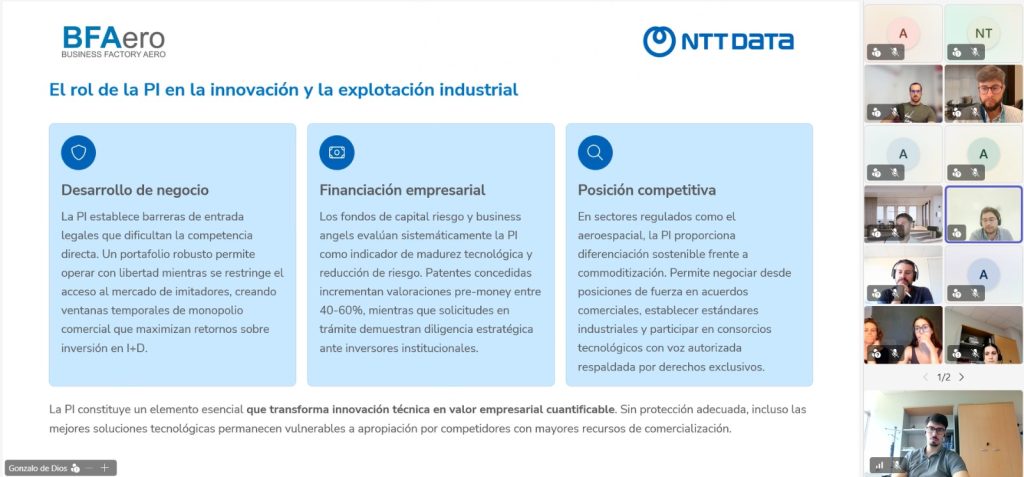
IP protects a company’s ability to grow, attract investment, negotiate with large corporations and maintain a sustainable competitive advantage. Numerous studies show that, in the aerospace sector, intellectual property accounts for up to 80 per cent of a company’s value and is one of the aspects most closely scrutinised by investment funds during due diligence.
Why is it so important for an aerospace start-up?
In a market as competitive as the aerospace sector, where development cycles are long and investment levels are high, protecting innovation effectively can make the difference between leading the market and losing it.
Industrial property refers to the set of rights that protect a company’s innovations, technological developments and distinctive signs. Its purpose is not merely to prevent others from copying a technology; it also enables:
- Increase the company’s valuation
- Creating barriers to entry against the competition
- Facilitate investment rounds
- Negotiating technology licences
- Monetising the results of R&D
- To strengthen the company’s position with customers and industry partners
What sort of industrial property does a company in the aerospace sector need?
The same technology may be protected simultaneously by several legal instruments, each designed to protect a different aspect of the project.
Patent. Protects a new, non-obvious technical solution with industrial application for up to 20 years, provided that the legal requirements are met. It is the best option in cases such as the development of a new propulsion system, the design of an innovative sensor or a new flight control system.
2. Copyright. This protects the original expression of a creation. It does not protect the idea itself, but rather its manifestation. Copyright arises automatically, although it is advisable to strengthen the evidence of authorship through registration or version control systems. It is particularly suitable for software, source code, interfaces, APIs, technical documentation, software architecture and graphic materials.
3. Databases. These protect the significant investments made in collecting, organising or verifying data. They are becoming increasingly important for companies developing artificial intelligence, autonomous navigation, predictive systems, fleet management platforms and Big Data-based solutions.
4. Trade secrets. These cover any information that derives its value precisely because it remains confidential. They are particularly recommended where technology is difficult to reverse-engineer or evolves very rapidly, such as predictive algorithms, AI models, training parameters, know-how, industrial processes, technical configurations or manufacturing strategies.
5. Brands. A means of safeguarding a company’s commercial identity. Essential for building a reputation and differentiating a company’s offering in international markets. A brand comprises the following elements: company name, logo, product name and slogan.
6. Industrial designs. These protect the external appearance of a product, its visual appearance. The shape of a drone, the exterior design of an aircraft, the casing of a sensor or the visual configuration of an autonomous robot.
Which is better: a patent or a trade secret?
The projects had the opportunity to address frequently asked questions, such as whether it is better to opt for a patent or a trade secret. Although in many cases the best strategy is to combine both approaches, there are differences between them.
A patent is more advantageous when the product can be easily copied, when it is necessary to showcase the technology to the market, when the aim is to attract investment, or when there is an interest in holding registered assets. Conversely, it is advisable to maintain secrecy when the technology cannot be easily discovered, when the know-how lies in internal processes, or when the innovation is constantly evolving.
Can industrial property generate income?
One of the most significant aspects of the session was the discussion of IP as a factor that generates economic value for the project. The main avenues for monetisation include:
- Marketing of protected technology products
- Technology licensing
- Assignment or sale of rights
- Creation of spin-offs
- Technology transfer agreements
- Utilización de la PI como activo en procesos de inversión o financiación
Además, disponer de una estrategia sólida de Propiedad Industrial mejora la posición negociadora frente a grandes empresas del sector aeroespacial y facilita la colaboración en proyectos internacionales de I+D+i.